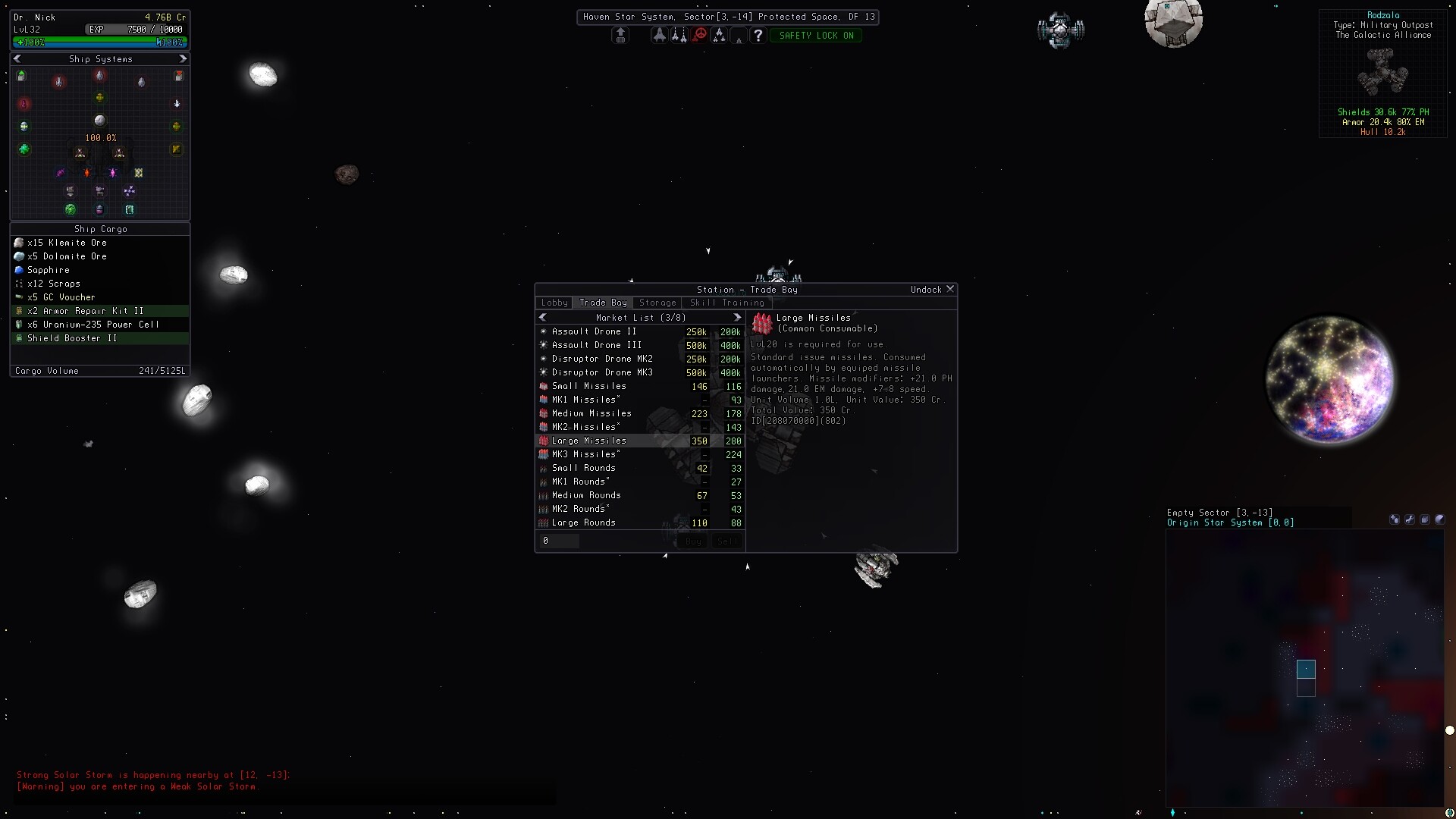
Trading in Sector Space happens at NPC Trade Bays with prices that vary by region and time; pair the Negotiation and Commerce secondary skills (formula ceiling near 89.5%) to get the most out of buy low / sell high runs. Salvage comes from a Salvager weapon in space and from the Disassembler (formerly Recycling Bay) at any station that has one.
More context
GC Vouchers sold at Capital Stations at 1:1 credit ratio, paired with a Colonial Management + Extraction build, turn a passive income stream alongside bulk trading runs. Ancient Debris from Strange Ruin Debris is most valuable when fed into the Disassembler instead of sold.
On this page
Trade at NPC Trade Bays
Industrial station
Sells mining gear and accepts large bulk salvage runs with faster stock refresh.
Best for: Bulk salvage and mining supply restocks
Capital station
Sells GC Vouchers and high-value items; GC Vouchers are 1:1 with credits.
Best for: Liquidating GC Vouchers and high-value trades
Military station
Sells weapons, ammo, and combat consumables.
Best for: Restocking Gauss Rounds and Missiles
GC Vouchers and Colonial income
GC Vouchers are sold at Capital Stations at a 1:1 credit ratio and are produced by Colonies alongside their normal resource outputs. A Colonial Management and Extraction build turns GC Vouchers into a passive income stream that pairs naturally with bulk trading runs.
Train Negotiation and Commerce
- Practical ceiling
- ~89.5% of the station's base price when both skills are maxed
- Formula
- ratio = 65% + 35% * (level * 0.4% + 30% if Commerce trained)
- Spread rule
- NPC sell prices are always higher than the station's base; the skill train is about the buy low, sell high side of the spread
Colonial Management and Extraction
Colonial Management (+0.5% colony taxation and items per level, +25% extractor yield on purchase) and Extraction (+0.75% extractor yield per level, +25% colony taxation on purchase) push the same passive-income loop. NPCs do not sell end-game items, so producing your own equipment becomes necessary past mid-game.
Salvage in space with a Salvager weapon
Salvage comes from two sources. In space, mount a Salvager weapon and sit near the wreck or debris field; it activates automatically when in range and consumes energy per shot. The salvage target has its own rarity:
- Strange Ruin Debris: 1-in-4 chance for Ancient Debris plus 1-in-25 chance of damaged or destroyed gear, tier-scaled.
- Ruin Debris: 1-in-16 chance for Ancient Debris.
- Ruin Wreck: 1-in-8 chance for Ancient Debris.
Spaceship wrecks use a tier-matched roll starting at the wreck's own tier (roughly 1-in-34 down to 1-in-28, rarer at higher tiers). If the first roll fails, the system cascades through higher tiers automatically, and a fallback 1-in-35 rolls for baseline gear. All salvaged gear comes at damaged or destroyed quality at 50/50 odds.
Recycle inventory items at the Disassembler
The Disassembler (formerly Recycling Bay) handles inventory items. To use it, dock at a station that has a Disassembler and feed items through it. Items with a known crafting recipe return their actual ingredients scaled by the Disassembler's efficiency percentage. Items without a recipe fall back to a value-based system that takes item credit value times quantity times efficiency, builds a candidate pool from the item's own tier and one tier below, and picks random items from that pool (only ones cheaper than the remaining value are eligible) until the value is used up.
Stocking the Disassembler with high-tier drops is the cleanest way to convert wander loot into crafting inputs without selling it at a loss.
Plan around price waves
Item prices fluctuate over time and across regions. Buy low in Protected or Neutral stations, sell high in Hostile or Fringe stations, and use Player Gateways to skip the travel cost. Pairing the trade route with a wormhole chase (see the exploration guide) is the fastest credit engine once both Negotiation and Commerce are trained past level 50.